Breeder Equilibrium Telemetry
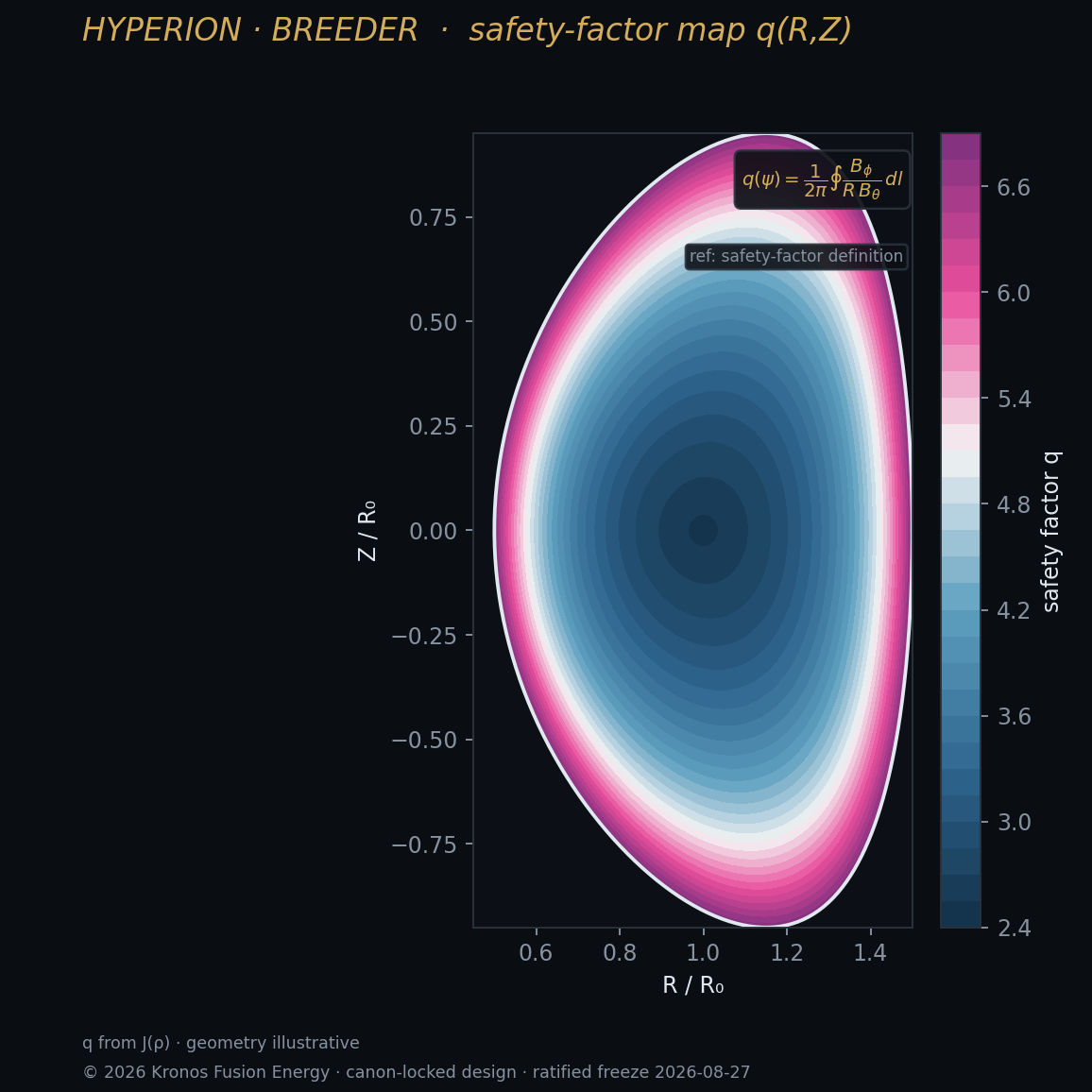
The telemetry that constrains the breeder's magnetic equilibrium — magnetics, profiles, shape — is the fabric's most safety-relevant feature set.
Equilibrium is the breeder's control problem
The breeder (Hyperion) is a spherical tokamak, R0 1.2 m, aspect ratio 2.5, running a negative-triangularity shape (delta -0.30) at 9.66 MA and 16.84 T peak field. Its central control problems are maintaining that equilibrium, holding the ELM-free negative-triangularity shape, and avoiding disruptions. The equilibrium telemetry set is the data that makes those problems tractable.
What constrains the equilibrium
- Flux loops: absolute boundary and internal flux.
- Mirnov coils: fast magnetics and mode structure.
- Core pressure map: the pressure that shapes the equilibrium.
- Coil-current telemetry: the fields the operator commands.
From telemetry to Grad-Shafranov
The magnetics and pressure constrain the Grad-Shafranov equation, whose solution is the equilibrium. The fabric provides a fast calibrated first fit; the L3 PINN refines it, solving the equilibrium natively (see flux-coordinate normalization). Because equilibrium underlies nearly every other feature, its telemetry is validated and cross-checked with extra rigor.
Shape and disruption
The negative-triangularity shape is what gives the ELM-free edge, so shape telemetry is control-critical. Disruption avoidance depends on the precursor features drawn from this same set — a locked mode in the Mirnov array, a pressure profile nearing a limit. The equilibrium telemetry is thus simultaneously the performance and the safety feed. Everything here is a design and validation specification for the machine whose FOAK first tritium is expected near 2030.