Breeder Control Problems
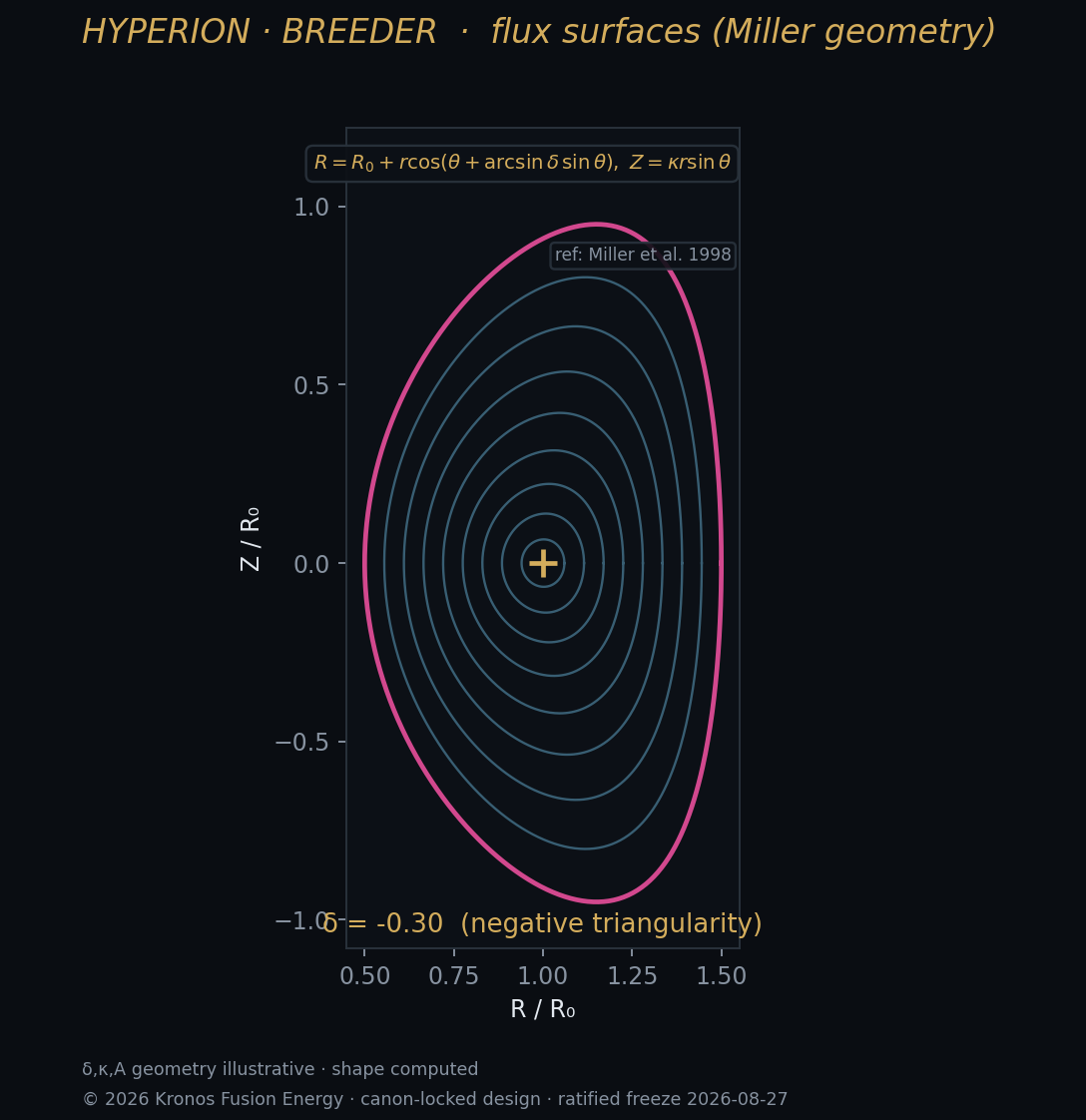
For Hyperion, the spherical-tokamak challenges are equilibrium, holding the negative-triangularity ELM-free shape, and disruption avoidance.
What the breeder must control
The breeder (Hyperion) is a D-T spherical tokamak with major radius R0 1.2 m, aspect ratio 2.5, Q_sci 3.076, 85.0 MW of fusion power, and 9.66 MA of plasma current. Its control problems are the classic tokamak set, sharpened by the compact spherical geometry and the chosen shape.
The three core problems
- Equilibrium — holding the plasma in force balance at 16.84 T peak field (8 T on-axis) against pressure and current gradients.
- Shape — maintaining the negative-triangularity (delta -0.30), ELM-free configuration that eases divertor loading.
- Disruption avoidance — detecting and steering away from the fast MHD instabilities that can terminate the discharge.
The equilibrium equation
Equilibrium control reasons about the Grad-Shafranov equation for the poloidal flux, which the L3 PINNs solve as a surrogate:
# Grad-Shafranov (axisymmetric MHD equilibrium)
# Delta* psi = -mu0 * R^2 * dP/dpsi  -  F * dF/dpsi
# psi : poloidal flux    P(psi): pressure    F(psi)=R*B_phi
# Solved as a PINN surrogate so equilibrium fits inside the control cycle.
Why negative triangularity is a control asset
The delta -0.30 shape suppresses edge-localized modes, which reduces transient divertor heat loads — but it must be actively held, because it is not the plasma's natural tendency. The twin's MHD module tracks the shape continuously and the MPC agent adjusts the shaping coils to keep it, all bounded by L1's deterministic actuation.
These problems are solved by the KRONOS-CTRL twin and executed within the sub-10 microsecond boundary.