Bootstrap Current and Profile Self-Consistency
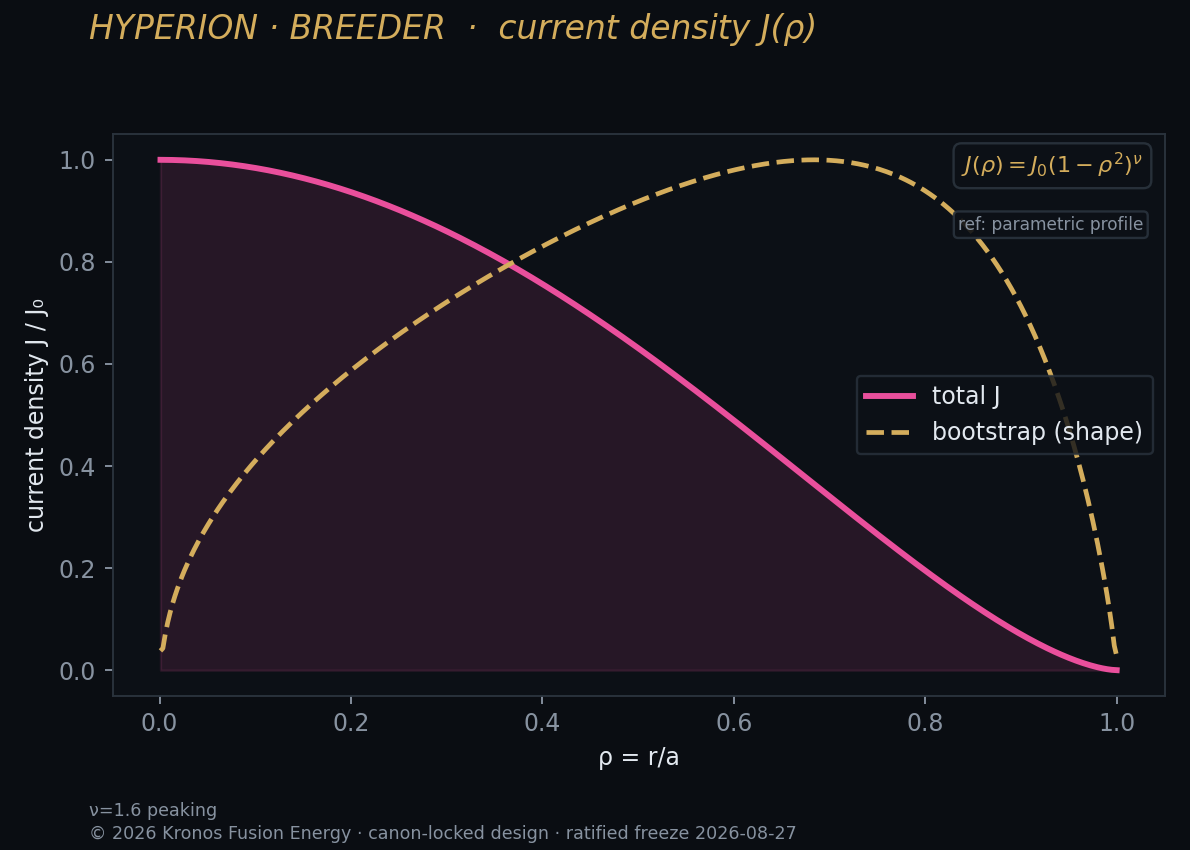
The plasma drives part of its own current; closing that self-consistency loop between pressure, current, and equilibrium is a fixed-point problem the twin must solve.
A self-driven current
In a toroidal plasma the pressure gradient drives a neoclassical bootstrap current parallel to the field. This current shapes the q profile, which shapes the equilibrium, which shapes the pressure - a coupled loop. For the breeder, the bootstrap fraction affects how much external current drive the 9.66 MA target needs and where rational surfaces land.
Bootstrap current (schematic neoclassical form):

  <J_bs . B> = -I(psi) p * [ L31 (dln p / dpsi)
                            + L32 (dln Te / dpsi)
                            + ... ]

  L31, L32 : neoclassical transport coefficients (collisionality,
             trapped-particle fraction, aspect ratio dependent)
  Bootstrap fraction f_bs = I_bootstrap / I_plasma
The fixed-point coupling
The total current is external (ohmic + auxiliary drive) plus bootstrap. But bootstrap depends on the pressure and the equilibrium, which depend on the total current. A self-consistent equilibrium requires iterating the Grad-Shafranov solve and the bootstrap model to a fixed point.
# self-consistent equilibrium + bootstrap fixed point
p_prof, T_prof = initial_profiles()
for it in range(max_it):
    psi   = solve_GS(from(p_prof, j_total))
    q     = q_profile(psi)
    j_bs  = bootstrap(p_prof, T_prof, psi)     # neoclassical
    j_tot = j_ext + j_bs
    if converged(j_tot, q): break
    j_total = relax(j_tot)                     # under-relax to stabilize
Why the AI cares
The bootstrap loop is expensive and stiff, and it must be re-solved whenever profiles change - which is constantly during a scenario. The stack learns a surrogate for the bootstrap-consistent equilibrium map so scenario optimization and MPC can evaluate candidate profiles without a full nested iteration. The surrogate is trained on the offline self-consistent solver and carries an uncertainty band.
- High f_bs reduces external current-drive demand but complicates control.
- Bootstrap-driven current can destabilize neoclassical tearing modes.
- The q profile it produces feeds directly into the stability spectra.
Bootstrap fraction is a design lever, not yet a measured quantity; the values used are simulation-based and will be re-anchored against reconstruction once the breeder operates.